This guide is for beginners who want to trade futures, and for stock or options traders thinking about the move. You will learn what a futures contract is, how margin and leverage work, which costs reduce your results, and how to go from choosing a broker to placing your first order.
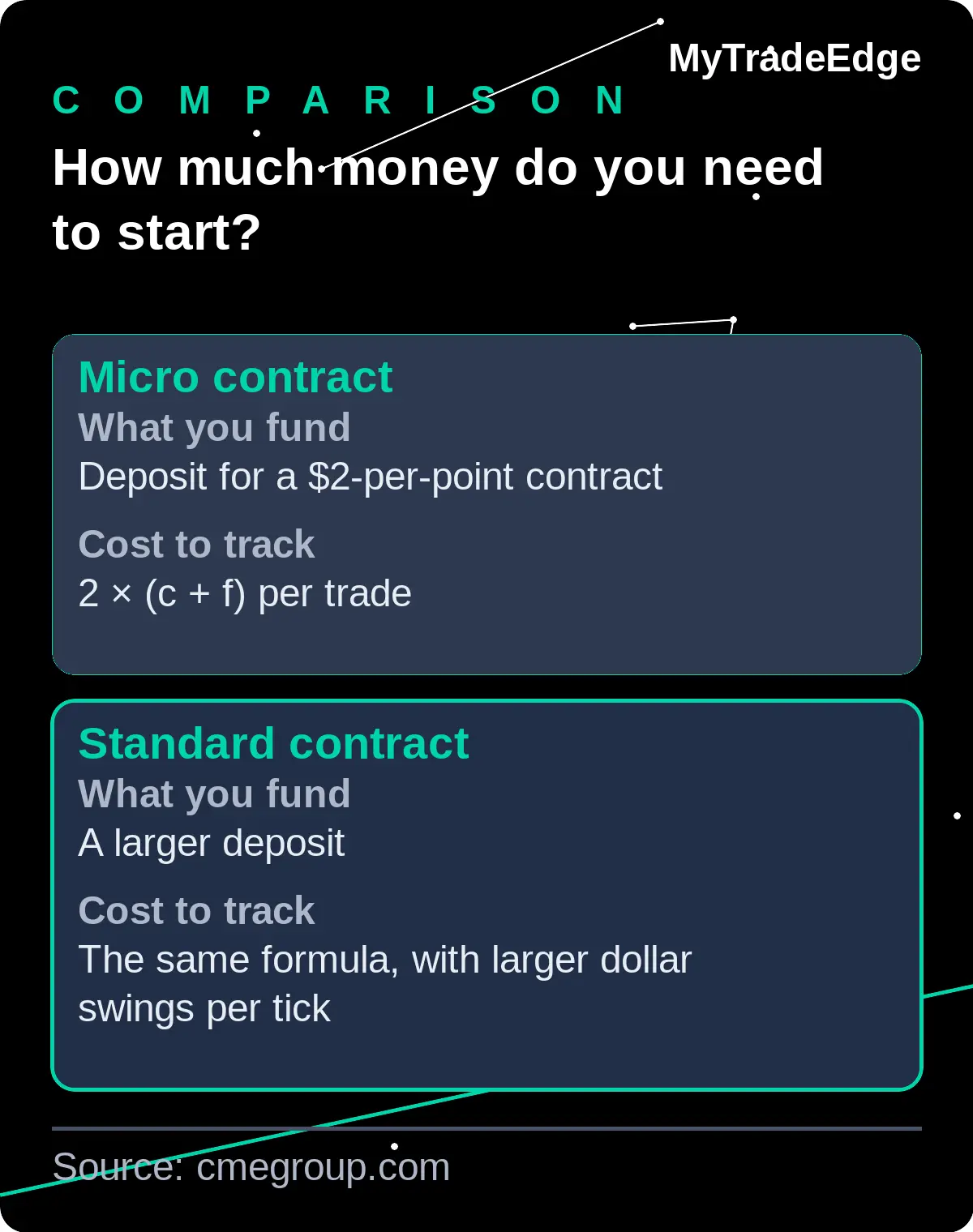
Start with a concrete picture. Say you expect the Nasdaq-100 to rise. Instead of buying 100 stocks, you buy one Micro E-mini Nasdaq-100 contract through your broker. Every index point the market gains adds $2 to your account; every point it loses takes $2 away. You only post a deposit, called margin, to open the position.
What is futures trading?
Before you place a first order, check these points:
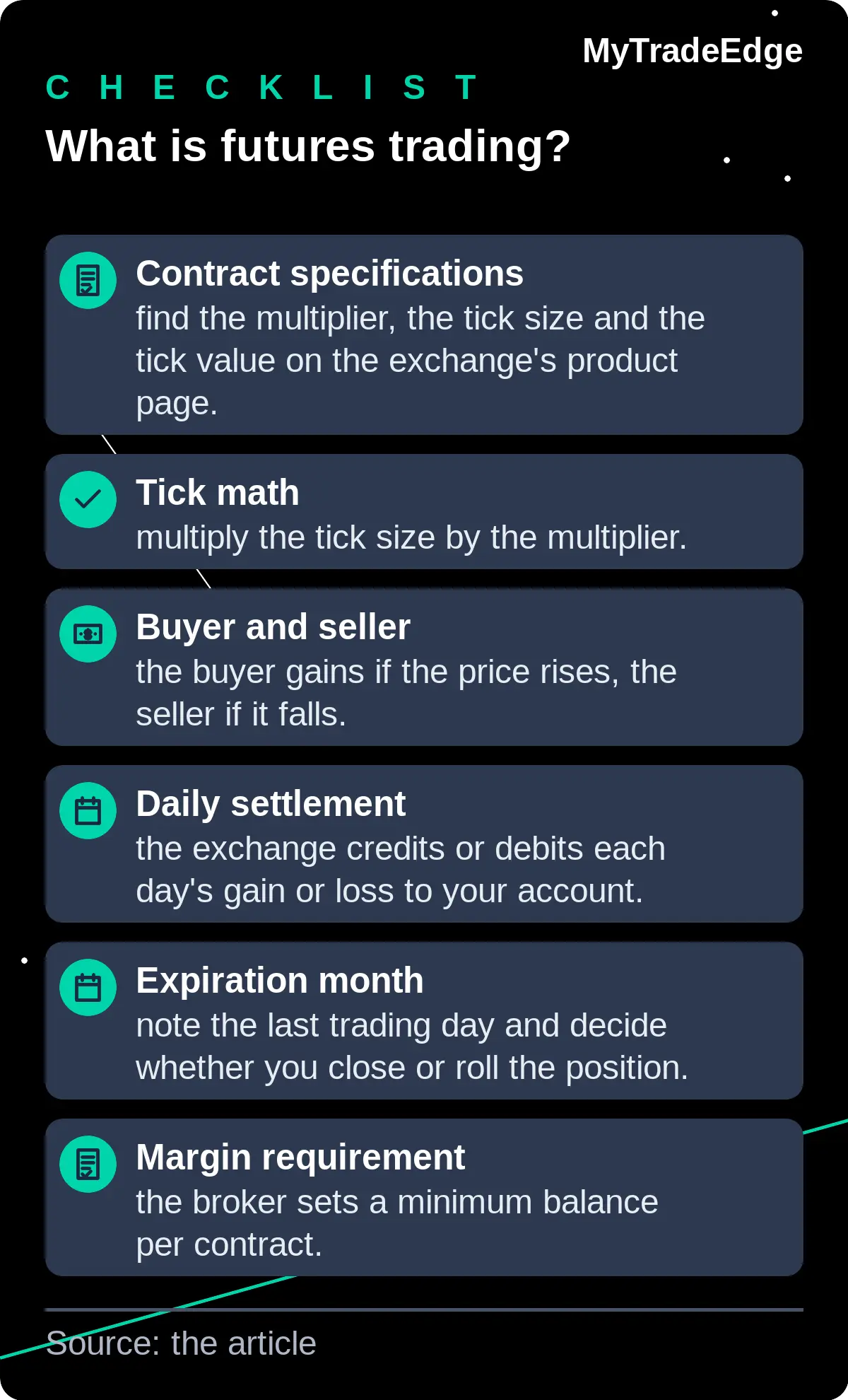
- Contract specifications: find the multiplier, the tick size and the tick value on the exchange’s product page. The multiplier converts a price move into dollars per contract.
- Tick math: multiply the tick size by the multiplier. The result is the tick value, the dollar effect of the smallest price move. Our NQ vs MNQ tick value guide works through it for the Nasdaq contracts.
- Buyer and seller: the buyer gains if the price rises, the seller if it falls.
- Daily settlement: each day’s gain or loss is credited to or debited from your account. Keep enough cash to cover a losing day.
- Expiration month: note the last trading day and decide whether you close or roll the position.
- Margin requirement: the broker sets a minimum balance per contract. A balance below that minimum triggers a margin call.
How much money do you need to start?
Initial margin vs intraday margin
The exchange sets the initial margin for each product. Your broker may ask for less on positions closed the same day. Both amounts change over time, so check the CME margin page and your broker’s schedule on the day you trade.
All-in cost per round trip
Round-trip cost = 2 × (broker commission + exchange fees + NFA fee)
Each charge applies on entry and again on exit. Take the figures from your broker’s fee schedule.
Worked example: one Micro E-mini Nasdaq-100 trade
- Contract: Micro E-mini Nasdaq-100, $2 per index point; one tick is 0.25 points, so one tick = 2 × 0.25 = $0.50.
- Assumed trade: buy 1 contract and sell it 20 points higher, which is 80 ticks. The 20-point move is an assumption, not a forecast.
- Gross P&L: 20 points × $2 = $40.
- Round-trip costs: 2 × (c + f), where c is your commission per side and f the exchange and regulatory fees per side.
- Net P&L = $40 − 2 × (c + f). If the trade loses 20 points instead, the net is −$40 − 2 × (c + f): costs are paid either way.
- Margin is not a cost. It is capital your broker holds while the position is open.
Contract size and tick: CME Group, Micro E-mini Nasdaq-100 contract specs.
How busy is the market?
Busy markets give you more counterparties when you enter or exit. CME Group reported a record average of 26.5 million contracts a day in 2024, and average daily volume from outside the United States rose 14%, to a record 7.8 million contracts. Source: CME Group, January 2025.
How do you place a trade, step by step?
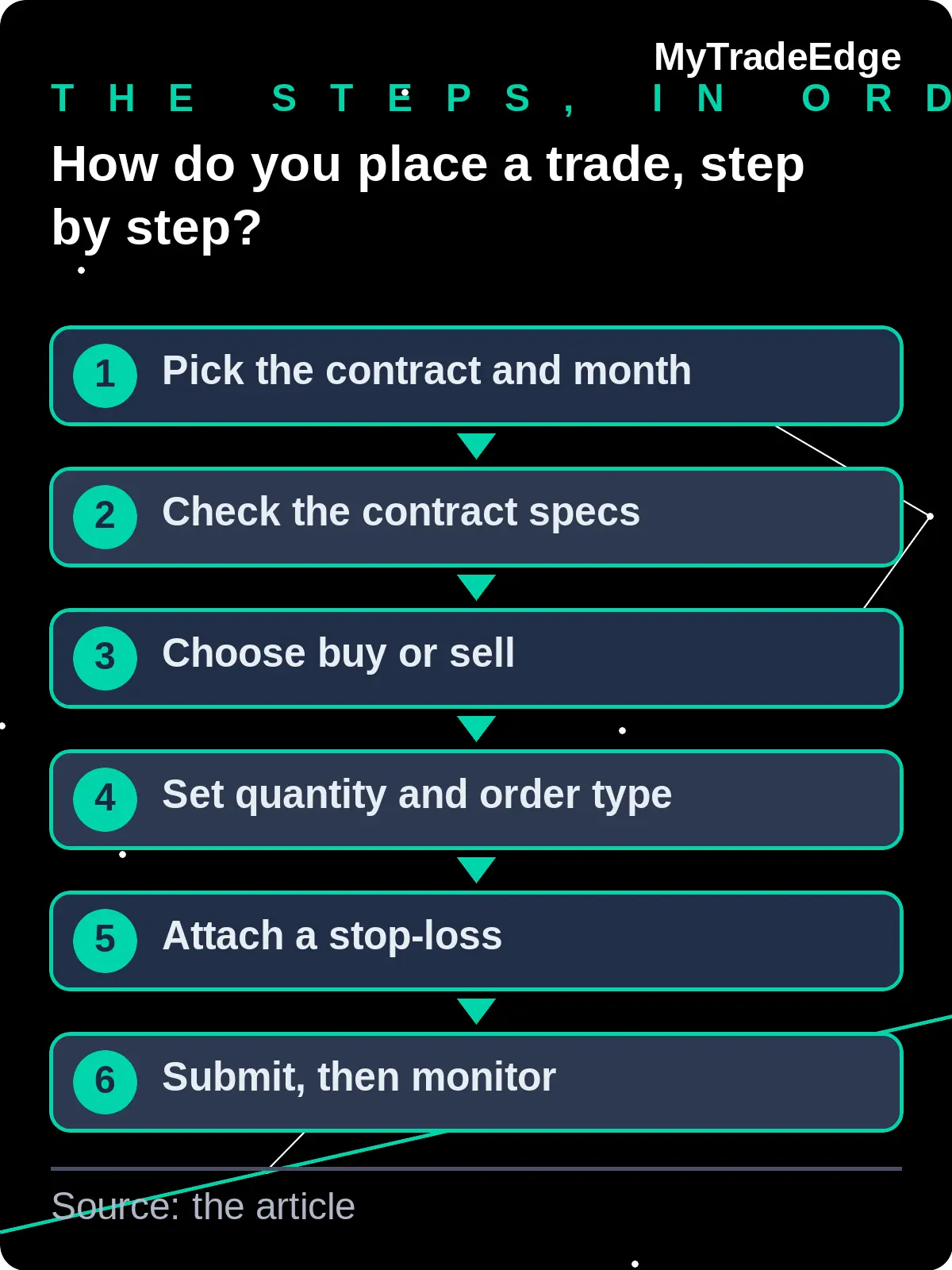
- Pick the contract and month. Search the symbol, then select the expiry with the most volume, usually the nearest active month.
- Check the contract specs. Read the tick size, tick value and margin requirement on your broker’s contract page.
- Choose buy or sell. Buy to go long if you expect a rise. Sell to go short if you expect a fall.
- Set quantity and order type. Start with one contract. Use a limit order to control the price, or a market order for an immediate fill.
- Attach a stop-loss. Place it where your trade idea is proven wrong. If you buy after a breakout, for example, the stop goes just below the breakout level.
- Submit, then monitor. Close the position before expiry, or roll it to the next month.
Before your first live order, a pre-market checklist keeps these steps consistent from day to day.
When does a contract expire, and how do you roll it?
The CME Group contract specs page lists the contract months, the termination of trading and the trading hours for each product.
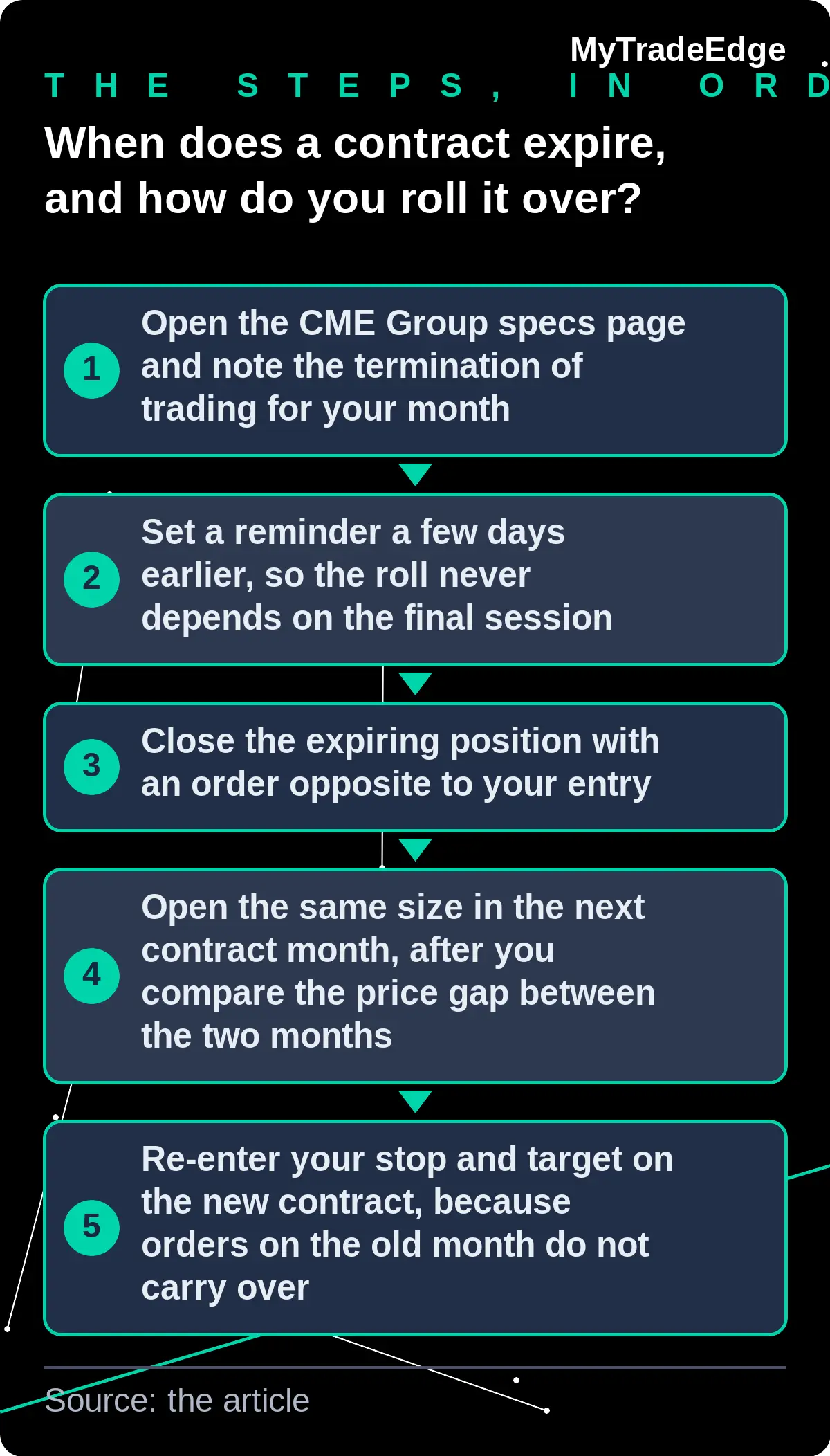
- Open the specs page and note the termination of trading for your month.
- Set a reminder a few days earlier, so the roll never depends on the final session.
- Close the expiring position with an order opposite to your entry.
- Open the same size in the next contract month, after you compare the price gap between the two months.
- Re-enter your stop and target on the new contract. Orders on the old month do not carry over.
Which platform do you need to start?
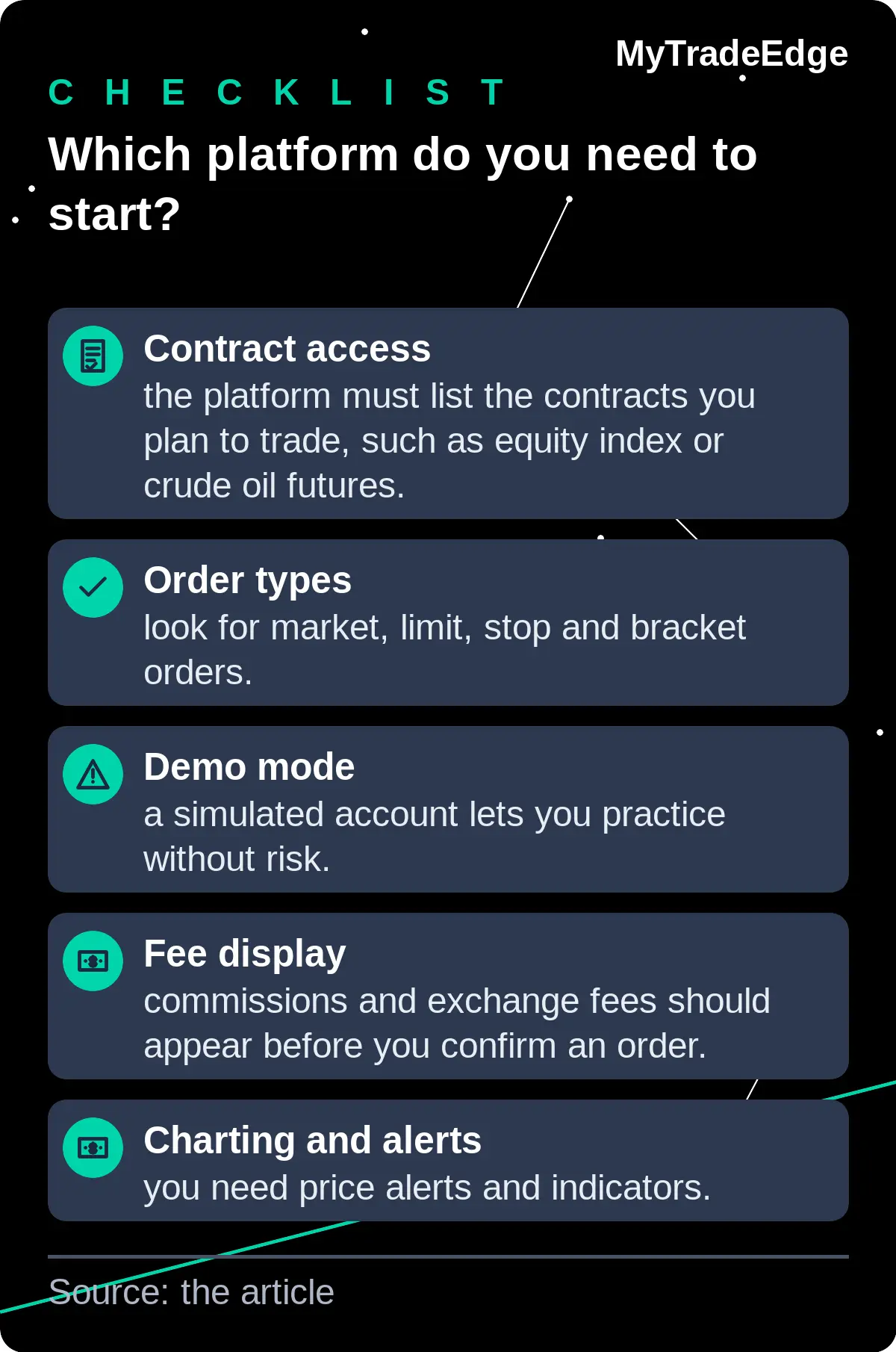
- Contract access: the platform must list the contracts you plan to trade, such as equity index or crude oil futures.
- Order types: look for market, limit, stop and bracket orders.
- Demo mode: a simulated account lets you practice without risk.
- Fee display: commissions and exchange fees should appear before you confirm an order.
- Charting and alerts: you need price alerts and indicators.
A simple test: in the demo, place a limit order with a stop attached, then check whether the screen shows your margin requirement and open profit and loss in real time. To compare two platforms on cost, put the commission per contract from each pricing page side by side.
Should you trade with a prop firm or your own account?
A futures proprietary trading firm gives you access to its capital after you pass a test, and you keep a share of the profits. To compare firms:
- Read the evaluation rules: profit target, daily loss limit and trailing drawdown.
- Check the profit split and the payout schedule.
- List every recurring fee: evaluation, reset, data and platform.
- Confirm which contracts and platforms the firm supports.
- Look for independent trader reviews and payout proofs before you pay.
A trailing drawdown can end an evaluation after one bad morning, while your own account would let you keep trading at a smaller size. If you cannot yet follow a written risk plan for several weeks, start with your own small account. Our prop firm comparison for NQ futures goes through the rules firm by firm.
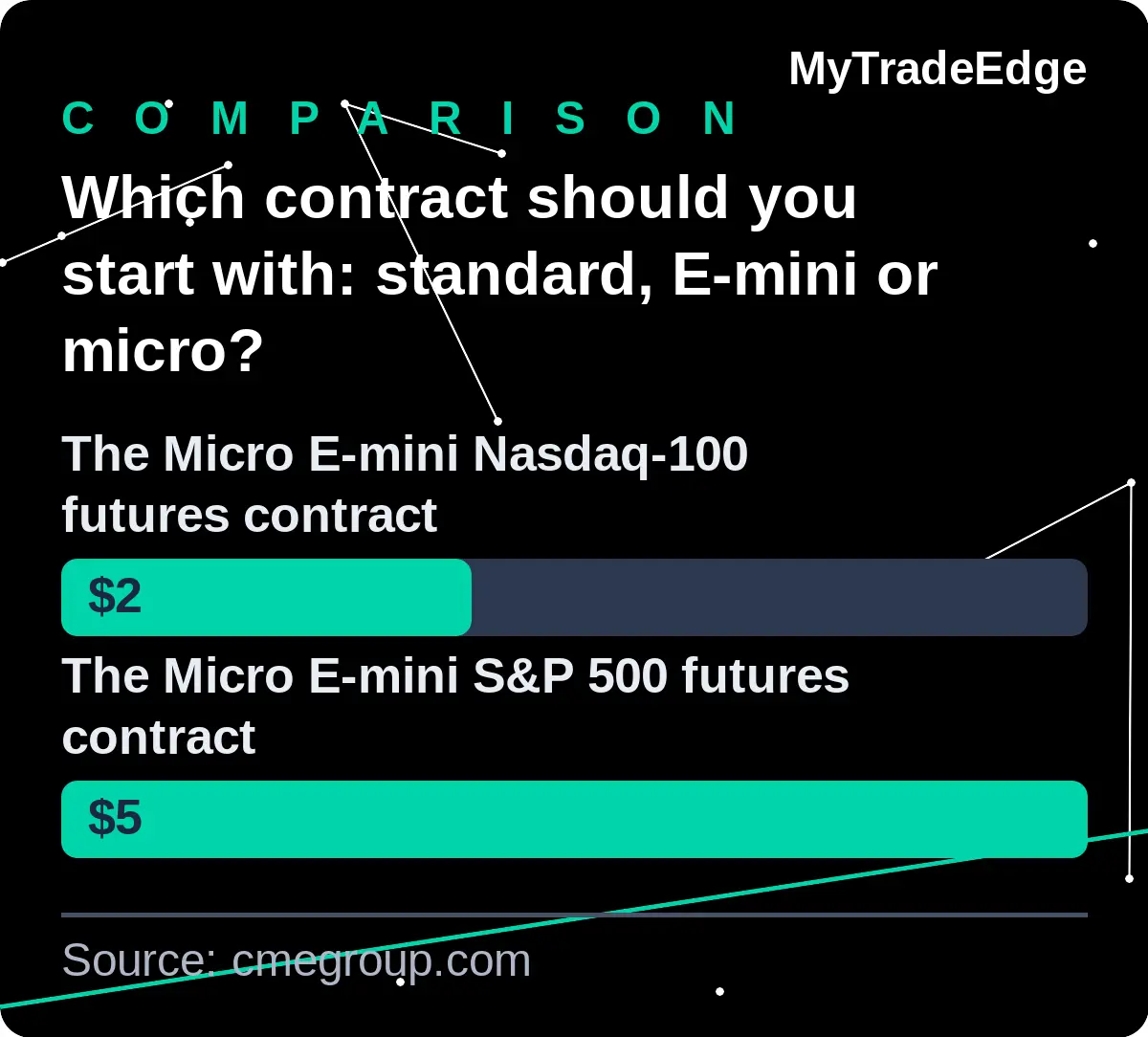
Which contract should you start with: standard, E-mini or micro?
| Contract | Multiplier | Minimum tick | Tick value |
|---|---|---|---|
| Micro E-mini Nasdaq-100 (MNQ) | $2 × index | 0.25 points | $0.50 |
| Micro E-mini S&P 500 (MES) | $5 × index | 0.25 points | $1.25 |
| E-nano (from August 2026) | One tenth of the Micro E-mini | See the CME contract specs | |
Source: CME Group contract specifications (Micro E-mini S&P 500); CME Group E-nano announcement, August 3, 2026.
Liquidity matters as much as size. According to CME Group, average daily volume in Micro E-mini Nasdaq-100 futures grew 23% in 2024, to 1.3 million contracts a day. Heavy volume generally means you can enter and exit without waiting for a fill.
If $2 per index point is still too much for your account, CME Group announced E-nano equity index futures in August 2026, sized at one tenth of the Micro E-mini contracts. Check with your broker whether they are offered.
What can go wrong, and how do you limit it?
- Set a maximum loss per trade in dollars before you place the order, and size the contract count to fit it.
- Place a stop-loss at the same moment you enter, not afterward.
- Keep cash in the account above the margin requirement, so a margin call does not force a sale.
- Avoid holding positions through scheduled news releases unless your plan covers them.
- Review your trade log weekly and cut size after a losing streak. A futures trading journal makes this review take minutes, not hours.
The exception: if you only hedge a physical position you already own, a loss on the future is offset by the underlying asset, so tight stops matter less.
When is the best time to trade?
Sessions and premarket. Equity index futures trade almost around the clock on CME Globex. “Premarket futures” means the hours before 9:30 ET, when the stock market is closed. Prices move then, but treat them as a preview, not a signal.
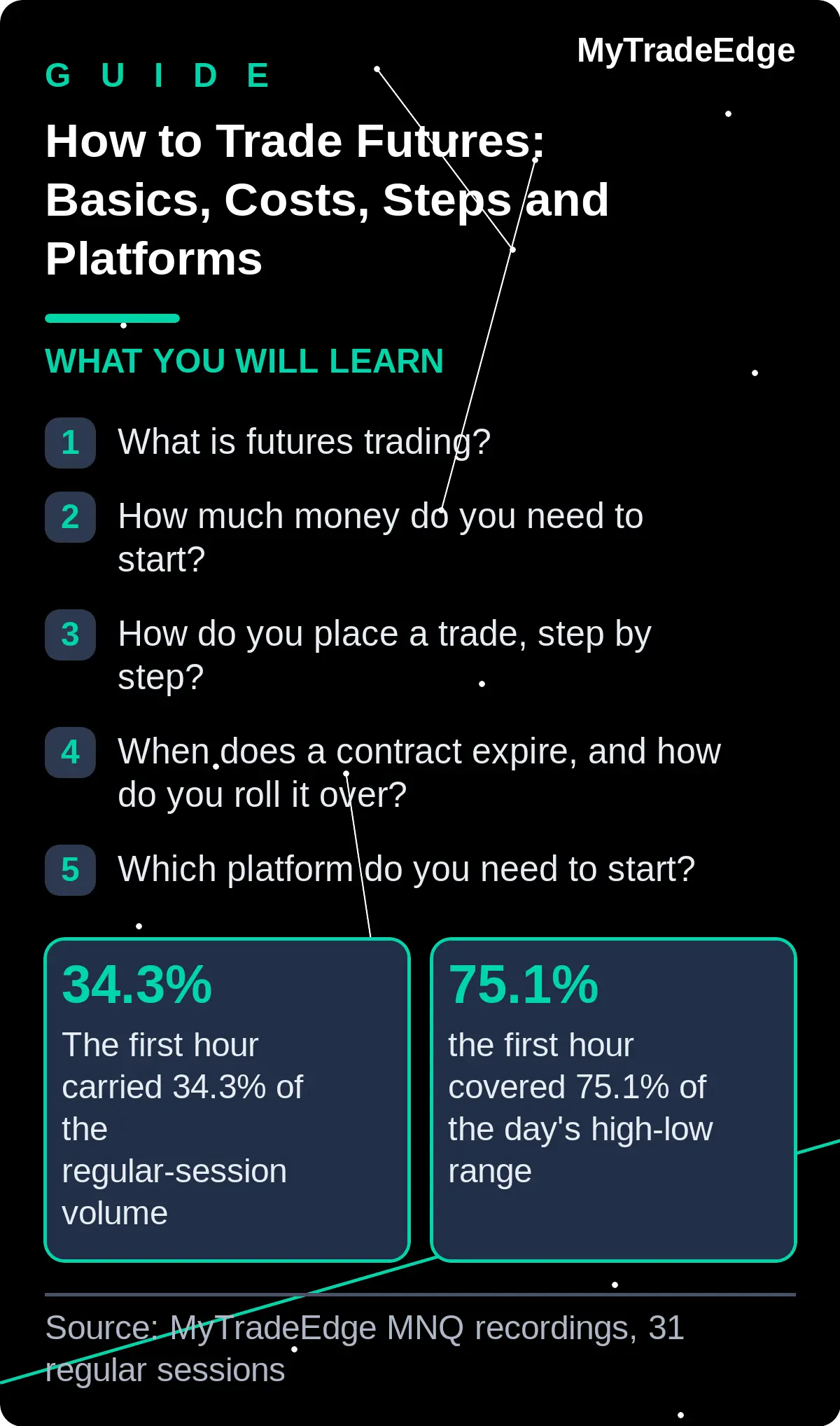
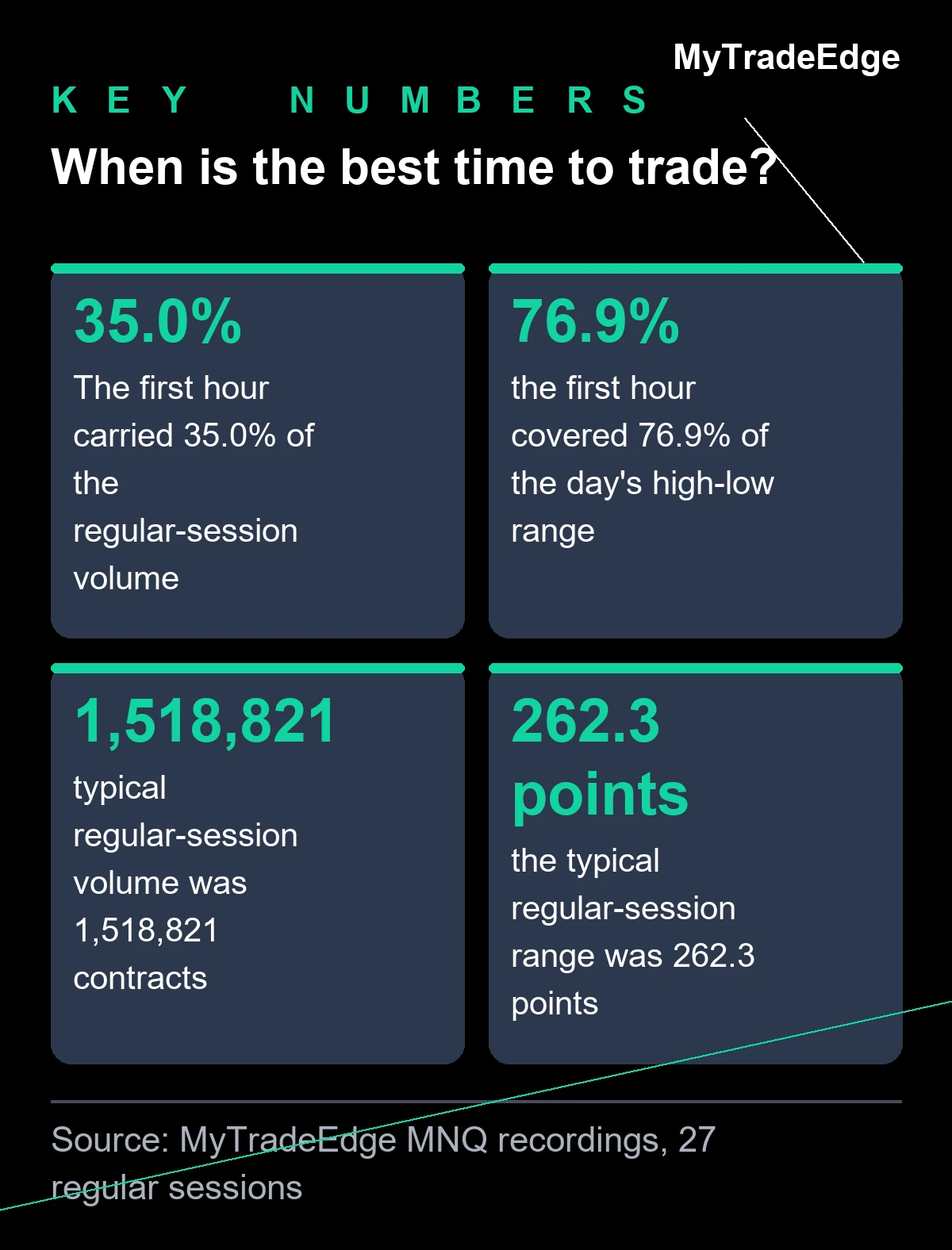
What we measured. MyTradeEdge recorded MNQ over 27 regular sessions, from August 17 to October 13, 2026 (methodology and per-session data). On a typical day, the first hour carried 35.0% of the regular-session volume and covered 76.9% of the day’s high-low range. A typical full session traded about 1.52 million contracts and moved about 262 points from low to high. For each figure, half of the sessions were below it and half above. For scale, CME Group reported that MNQ averaged 2.4 million contracts a day in September 2026 (CME Group, October 2, 2026); that figure covers the whole trading day and all contract months, while ours covers only the regular session of the front month.
What it does not show. The data cover MNQ only, and only the regular session. They describe one period; they are not a forecast or a rule, and they say nothing about other contracts.
How to use it. Mark the first hour on your calendar, practice it in a simulator before risking money, and log each entry by clock time, so your own record shows which hour suits you. If you cannot watch the screen at 15:30 CET, test a later hour in simulation and judge it on your own log.