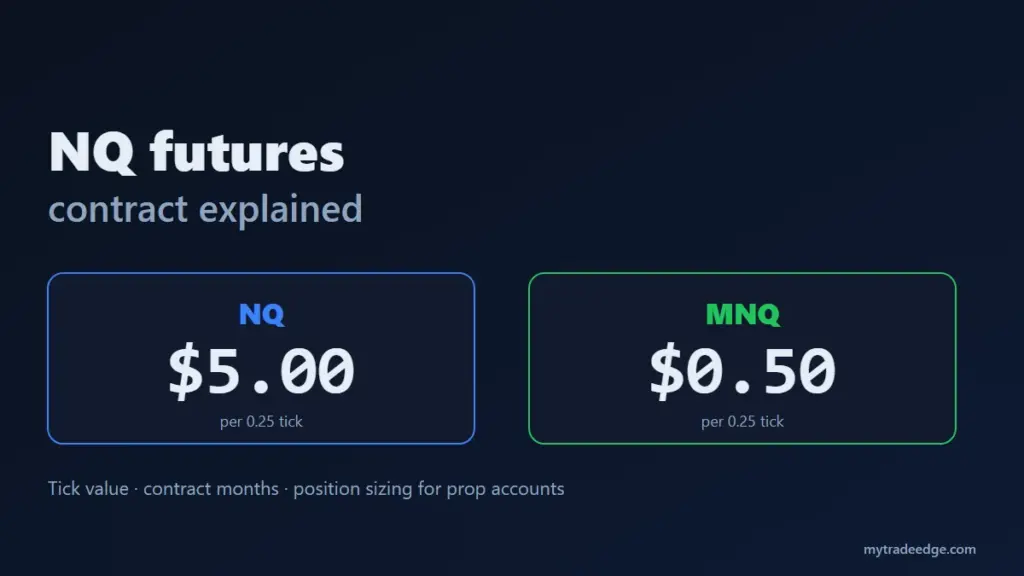
The NQ futures contract is the E-mini Nasdaq-100 future traded on CME Globex. Each contract is worth $20 times the Nasdaq-100 index, it moves in ticks of 0.25 index points, and every tick is worth $5.00. Its smaller sibling, MNQ (Micro E-mini Nasdaq-100), is exactly one tenth of the size: $2 times the index, $0.50 per tick (CME Group, NQ specs; CME Group, MNQ specs).
Those two numbers decide almost everything else: how much a 20-point stop costs, how many contracts fit a prop firm loss limit, and whether you should start on NQ or MNQ. This guide walks through the contract specifications, the math, and a sizing table you can use before your next trade.
What are the NQ futures contract specifications?
NQ is cash-settled, trades almost 24 hours a day from Sunday evening to Friday afternoon, and is listed in a quarterly cycle. The key specs are below; MNQ shares the same schedule, tick size and expiration rules.
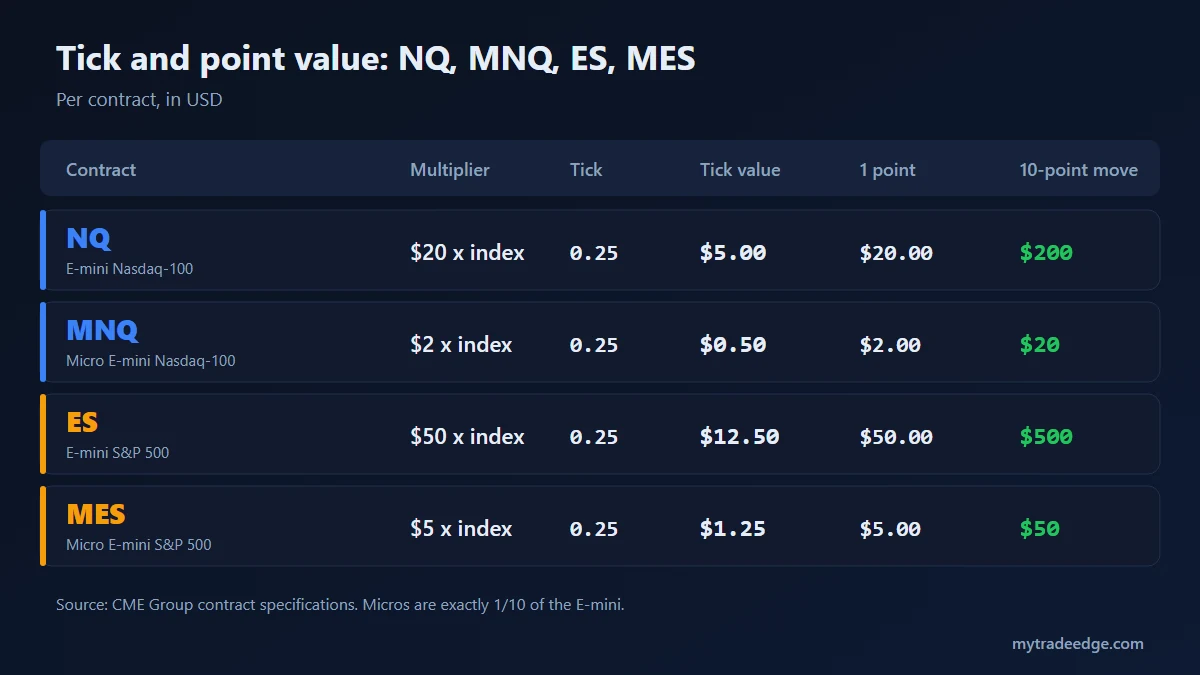
| Specification | NQ (E-mini Nasdaq-100) | MNQ (Micro E-mini Nasdaq-100) |
|---|---|---|
| Contract unit | $20 x Nasdaq-100 index | $2 x Nasdaq-100 index |
| Minimum tick | 0.25 index points = $5.00 | 0.25 index points = $0.50 |
| Value of 1 point | $20 | $2 |
| Trading hours (CME Globex) | Sunday 6:00 p.m. to Friday 5:00 p.m. ET, daily break 5:00 to 6:00 p.m. ET | |
| Contract months | March, June, September, December (5 consecutive quarters listed) | |
| Settlement | Financially (cash) settled | |
| Last trading day | 9:30 a.m. ET on the third Friday of the contract month | |
Source: CME Group contract specification pages linked above. Specs can change; the CME page is the reference if anything here differs.
What is the NQ tick value, and how do you calculate profit and loss?
One NQ tick is worth $5.00 and one point (four ticks) is worth $20. To calculate profit or loss, multiply the points gained or lost by $20 and by the number of contracts. For MNQ, use $2 per point instead.
Examples:
- Long 1 NQ at 20,000.00, exit at 20,012.50: +12.5 points x $20 = +$250.
- Short 3 MNQ at 20,000.00, stopped at 20,010.00: -10 points x $2 x 3 = -$60.
- A 100-point day in the index: $2,000 per NQ contract, $200 per MNQ contract.
Remember to subtract round-turn commissions and exchange fees. Your broker’s fee schedule lists them; they are charged per contract, so ten MNQ cost more in fees than one NQ for the same dollar exposure.
NQ vs MNQ: which one should you trade?
Trade MNQ when your planned risk per trade is too small for a full NQ contract at your stop distance, or when you want to scale in and out in small steps. Trade NQ when your risk budget fits whole contracts comfortably and you want lower fees per dollar of exposure.
| NQ | MNQ | |
|---|---|---|
| Dollar value per point | $20 | $2 |
| Notional at an index level of 20,000 | $400,000 | $40,000 |
| Cost of a 20-point stop | $400 | $40 |
| Sizing flexibility | Steps of $20/point | Steps of $2/point |
| Fees per $ of exposure | Lower | Higher (10 contracts to match 1 NQ) |
Notional value is the index level times the multiplier. The 20,000 level above is only an example for the math; check the live quote for today’s value. Margin requirements are set by the exchange and by your broker and change over time, so take them from your broker, not from an article.
How many MNQ contracts can you trade for your risk?
Divide your dollar risk per trade by the dollar cost of your stop for one contract, and round down. For MNQ the cost of the stop is stop points x $2; for NQ it is stop points x $20.
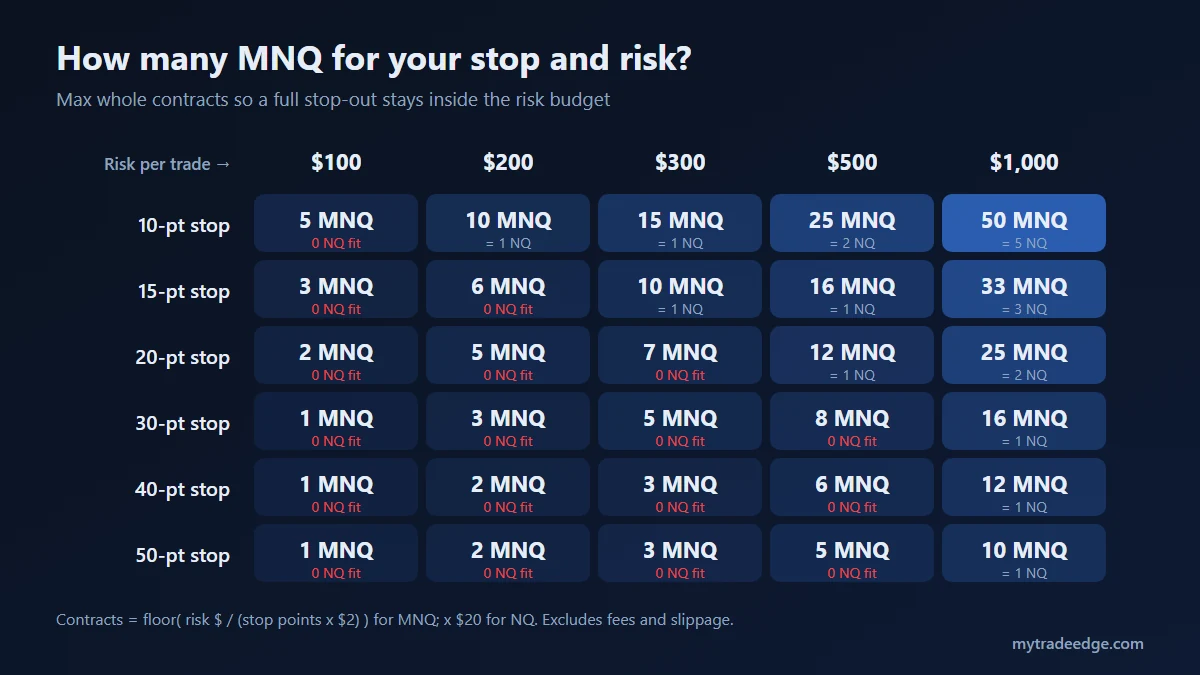
Worked example: you risk $300 per trade with a 20-point stop. One MNQ costs 20 x $2 = $40 if stopped, so $300 / $40 = 7.5, which rounds down to 7 MNQ. One NQ would cost $400, which is over budget, so NQ does not fit this trade at all.
Two rules of thumb fall out of the grid:
- With a 20-point stop, one NQ needs at least $400 of risk per trade. Below that, MNQ is the only way to keep the stop where the setup says it should be.
- Do not tighten the stop to fit a bigger size. If the trade needs 30 points of room, size for 30 points.
Slippage matters more during fast markets such as the 9:30 ET open or major economic releases. Leaving a few dollars of buffer in the calculation is a sensible habit.
How do NQ contract months and the roll work?
NQ and MNQ expire four times a year, in March (H), June (M), September (U) and December (Z). The symbol combines the root, the month code and the year: NQZ6 is the December 2026 E-mini, MNQH7 the March 2027 micro.
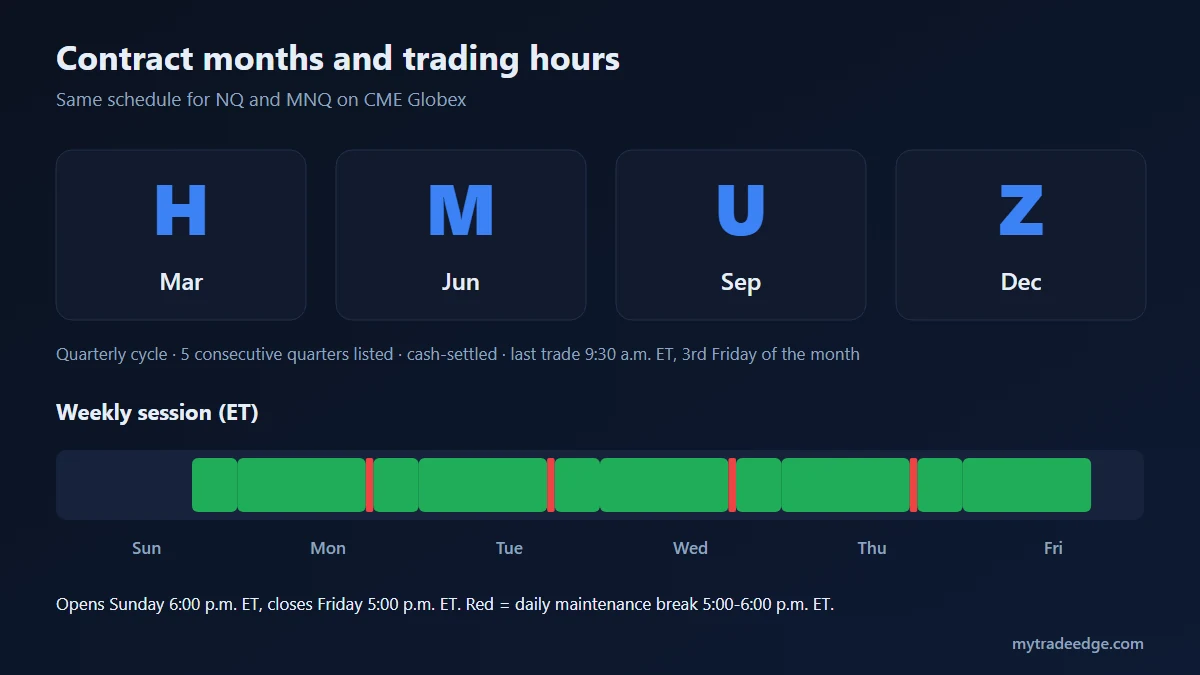
Trading in the expiring contract ends at 9:30 a.m. ET on the third Friday of the month. Most volume moves to the next quarter in the days before that, which is what traders call the roll. Practical points:
- Make sure your chart and your order ticket show the same month. A chart on the new month and an order on the old one is a classic expiry-week mistake.
- The two months trade at different prices, so levels drawn on the old contract may not line up on the new one.
- Log the full symbol in your trading journal so roll-week trades are not mixed up.
How does the NQ compare with ES?
ES (E-mini S&P 500) uses the same 0.25 tick but a larger multiplier: $50 per point, so $12.50 per tick. MES, the micro, is $5 per point and $1.25 per tick. The two indexes sit at very different levels and move by different numbers of points, so a point on one is not comparable to a point on the other.
When you compare the two, compare dollars of risk, not points. A 10-point stop on ES costs $500 per contract; a 10-point stop on NQ costs $200. Size each one from your dollar risk, using the same formula as above.
Sizing NQ in a prop firm account
Convert the firm’s dollar limits into NQ points before the session. A $1,000 daily loss limit equals 50 NQ points on one contract, or 500 MNQ points on one micro. If your stop is 25 points, that limit covers two full NQ stop-outs, or twenty full MNQ stop-outs on one micro.
Trading MNQ in an evaluation gives you ten times more room between a normal losing streak and the limit. Rules differ between firms and change often, so read the current rules on the firm’s help center. For an overview of firms that support NQ, see our guide to the best prop firms for NQ futures. The MyTradeEdge journal can track daily loss limits and drawdown for prop accounts while you trade.
Before your next NQ trade
- Decide the stop in points from the setup, not from the size you want.
- Multiply by $20 (NQ) or $2 (MNQ) to get the cost of one contract.
- Divide your dollar risk by that cost and round down.
- Check the symbol month on both chart and order ticket.
- Log the trade with contract, size, stop and result in R.
If you want to test a setup on historical NQ and MNQ data before risking money, the MyTradeEdge backtest engine runs strategies on tick-level data.